Asia Pacific E-Bike Industry Analysis 2026–2034: Market Growth, Trends & Opportunities
According to the latest research report titled "Asia Pacific E-Bike Market Size, Share, Trends and Forecast by Mode, Motor Type, Battery Type, Class, Design, Application, and Country, 2026-2034" the report offers a comprehensive analysis of the industry, including market share, growth, trends, and regional insights.
How Big is the Asia Pacific E-Bike Industry?
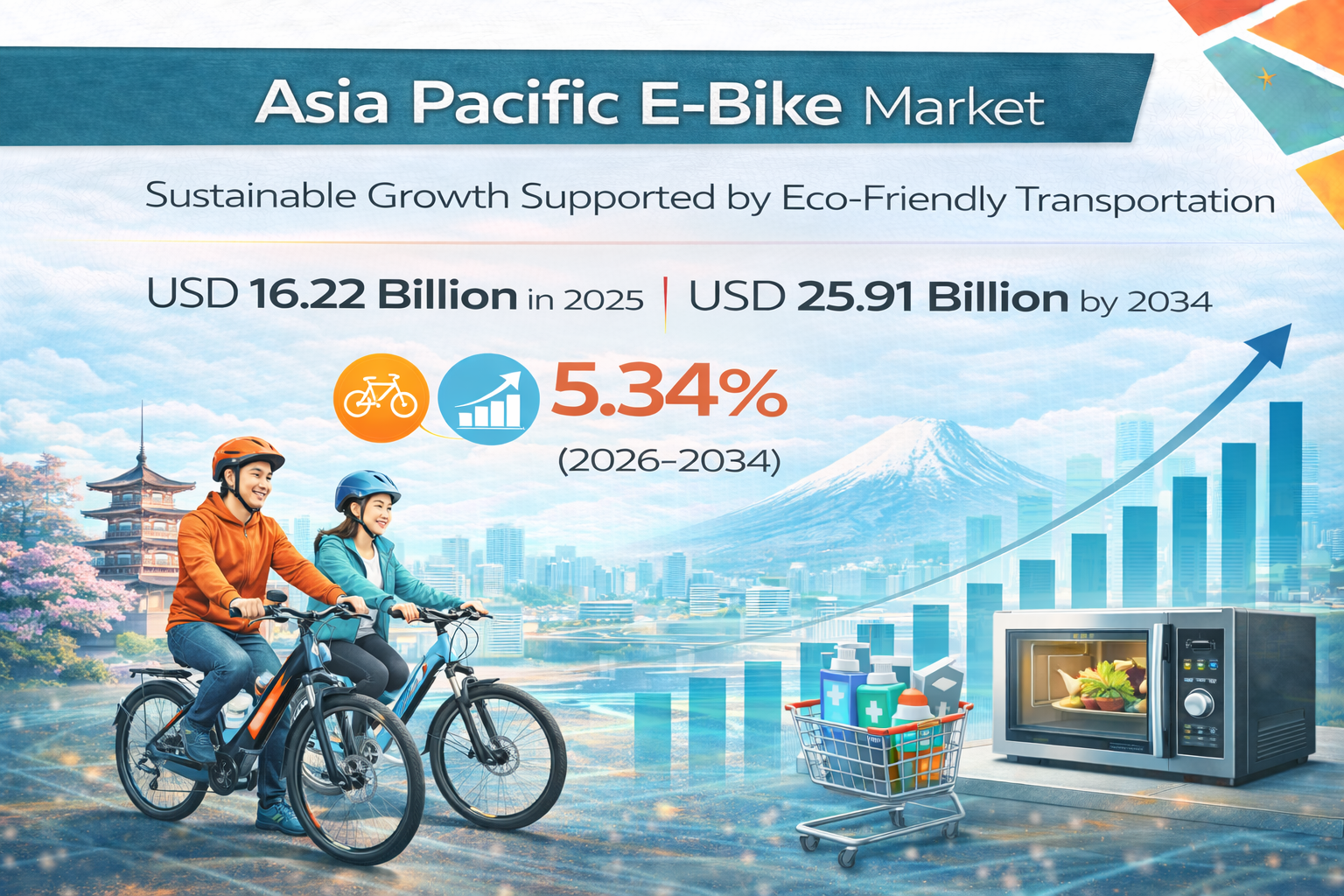
The e-bike market size in Asia Pacific was valued at USD 16.22 Billion in 2025 and is projected to reach USD 25.91 Billion by 2034, growing at a compound annual growth rate (CAGR) of 5.34% from 2026-2034. The market is driven by rapid urbanization, worsening traffic congestion in major metropolitan areas, and growing environmental consciousness accelerating e-bike adoption across the region. Government incentives promoting electric two-wheelers, advancements in lithium-ion battery technology, expansion of dedicated cycling lanes, and the integration of smart connectivity features are further reshaping the competitive landscape and accelerating market expansion. The report presents a thorough review featuring the Asia Pacific e-bike market share, growth, trends, and research of the industry.
Note: Download a Free Sample PDF of the Report from the Website
What are the Latest Emerging Trends in Asia Pacific E-Bike Market?
- Increasing Disposable Income and Middle-Class Expansion
Increasing demand for Asia Pacific e-bike market is attributed to rise in disposable income and expanding middle-class population․ This leads to higher affordability for premium and smart two-wheelers as per country statistics․ In India's fiscal year 2024-25‚ as per the Ministry of Statistics‚ Net National Income per capita grew from ₹1‚88‚892 in FY2023-24 to ₹2‚05‚324‚ owing to greater earnings and increasing spending patterns․ This trend is particularly pronounced in emerging economies‚ where rising incomes and a growing urban professional working population are demanding better‚ more efficient‚ and more reliable forms of transport․ These features favor the e-bike as a transportation mode for daily commuting‚ and it is popular across all income groups․
- Enhanced Urban Mobility and Last-Mile Connectivity
E-bikes offer a response to the increased demand for flexible and accessible technologies for last mile transport in ever denser urban environments‚ where they can navigate narrow roads‚ save time‚ connect residential neighbourhoods with public transport‚ workplace and commercial areas more directly‚ and are also easier to park and store․ SoftBank's OpenStreet launched an electric moped-style sit-down bicycle in 2024 on its HELLO CYCLING bike share system in Japan․ Co-developed with Japan's cities of Chiba and Saitama‚ the e-bikes help fill in gaps in the public transportation system and provide an environmentally-friendly last mile transport solution․
- Improvements in Battery and Motor Systems
Continuous improvements in battery efficiency‚ powertrain performance‚ and energy management systems are expected to propel e-bike demand in the Asia Pacific region․ Improved lithium-ion battery technology offers a high range‚ increased battery life‚ and short charge times‚ thus propelling market advancement in the region․ Automated and higher rated motors with greater torque allow for smoother acceleration․ In 2024‚ JATCO Ltd and HODAKA CORPORATION developed a prototype e-assist bicycle with JATCO's 2-in-1 drive unit (combining a motor and gearbox) and signed an MOU for mass production in 2025․ Automotive powertrain technology is promoting the entry of e-mobility technology and expanding the e-mobility market in the region․
What Growth Factors are Driving Asia Pacific E-Bike Market?
- Expansion of E-Commerce and Online Distribution Channels
Sales through e-commerce and other digital channels are also providing a major push for the adoption of e-bikes in the Asia Pacific region as consumers can easily compare through the internet and make a purchase online with ease and convenience․ Manufacturers can reach distant and underserved markets with lower reliance on dealerships․ With e-commerce expected to grow from USD 125 billion in 2024 to USD 345 billion by 2030 according to IBEF (Indian Business of E-commerce Federation)‚ a compounded annual growth rate (CAGR) of 15%‚ there is strong growth in this channel that can be leveraged for the enduring growth of the e-bike market segment․
- Innovation in Self-Charging and Regenerative Drive Technology
Next to technological advances for regenerative drive systems which further enable the Asia Pacific e-bike market to become more convenient‚ efficient‚ and sustainable‚ Japanese cleantech startup Hello Space presented its patented MAG DRIVE for the first time at CES 2026․ The semi superconducting regenerative drive system allows e-bikes to charge their batteries with pedaling without generating magnetic resistance․ While the vehicle was designed and developed with the assistance of XERO and Toyota Tshusho Nexty Electronics Group‚ with an emphasis on advancing energy-harvesting systems as a viable alternative to charging stations and energy efficiency to assist with extending the vehicle's range‚ it marks a growing prevalence for the technology․
- Cost-Effective and Energy-Efficient Transportation
E-bikes provide a cheaper alternative than gasoline-powered vehicles and generally have lower operating and maintenance costs․ Because e-bikes have a lower energy consumption than motor vehicles‚ commuters can save on transportation costs‚ since cheaper electricity or battery charging can replace gasoline․ In locations where transportation cost is otherwise going up‚ e-bikes are becoming an energy-efficient and cost-effective option for commuting and short-distance trips․ Cost is one of several factors driving the adoption of e-bikes‚ especially in price-sensitive markets in developing countries: India‚ Indonesia and other developing countries have the greatest share of economically constrained end-users․
- Government Incentives and Sustainable Urban Mobility Initiatives
Asian governments support electrification of two-wheelers with a variety of measures including subsidies‚ tax exemption and development of cycling infrastructure (bike lanes‚ bike parking‚ urban mobility)․ Regulatory measures in several Asian countries are more favorable towards Class I pedal-assist e-bikes that do not require special licensing or registration and have lower barriers to entry․ These policy tailwinds‚ as well as an increasing commitment to sustainability from corporates and fleet operators‚ are likely to create favorable long-term market conditions across the region․

How will the Asia Pacific E-Bike Market Evolve in the Coming Years?
The Asia Pacific e-bike market outlook remains positive‚ driven by sustained urbanization‚ evolving regulations‚ domestic manufacturing capabilities‚ and growing demand for green mobility․ These factors are expected to continue driving value growth in all product categories‚ despite rising competition from well-established multinational companies and emerging homegrown players in the regional market․ Improvements in battery technology‚ along with the continued expansion of cycling infrastructure‚ are also expected to support strong demand growth․
With a growing demand for smart‚ sustainable and affordable urban mobility‚ the Asia Pacific e-bike market is expected to see revenue growth across all segments‚ owing to AI-powered connectivity‚ regenerative drive technology‚ and the use of e-bikes for cargo mobility‚ which will bring about long-term structural changes to the region's e-bike market․
Asia Pacific E-Bike Market Segmentation
Mode Insights:
- Throttle
- Pedal Assist
Motor Type Insights:
- Hub Motor
- Mid Drive
- Others
Battery Type Insights:
- Lead Acid
- Lithium Ion
- Nickel-Metal Hydride (NiMH)
- Others
Class Insights:
- Class I
- Class II
- Class III
Design Insights:
- Foldable
- Non-Foldable
Application Insights:
- Mountain/Trekking Bikes
- City/Urban
- Cargo
- Others
Country Insights:
- China
- Japan
- India
- South Korea
- Australia
- Indonesia
- Others
Key Players
The report offers an in-depth examination of the competitive landscape, including market structure, key player positioning, leading strategies for success, a competitive dashboard, and a company evaluation quadrant.
Recent Developments & News:
In November 2025, a new shared e-bike service launched in Matsue, Japan, aiming to enhance regional mobility and tourism across Matsue and Izumo by integrating rail, waterway, and e-mobility options to create a seamless travel experience, offering visitors an eco-friendly way to explore historic sights including former samurai residences in Matsue's Shiominawate district.
In May 2025, Reliance Jio announced its entry into the EV market with the launch of its e-bike, featuring a modern design, advanced technology, and multiple variants targeting a wide range of customers, with a focus on comfort, safety, and connectivity aimed at tapping into India's rapidly growing EV sector.
Key Highlights of the Report
- Comprehensive analysis of the Asia Pacific e-bike market size, share, and forecast through 2034.
- Detailed segmentation by mode, motor type, battery type, class, design, application, and country.
- Insights into market dynamics including growth drivers, restraints, and competitive landscape.
- Examination of government policies and urban mobility initiatives impacting e-bike adoption across the region.
- Evaluation of technological trends including battery innovation, regenerative drive systems, and smart connectivity features.
- Coverage of recent investments, product launches, and developments across the Asia Pacific e-bike industry.
Frequently Asked Questions:
1. How large is the Asia Pacific e-bike market?
➤ The Asia Pacific e-bike market was valued at USD 16.22 Billion in 2025.
2. What is the expected growth rate of the market?
➤ The market is projected to grow at a CAGR of 5.34% from 2026 to 2034, reaching USD 25.91 Billion by 2034.
3. Which mode leads the market?
➤ Pedal assist holds the largest share at 65%, driven by its seamless integration of human effort and electric propulsion that appeals to health-conscious commuters seeking efficient, eco-friendly transportation across diverse urban terrains.
4. What factors are driving market growth?
➤ Growth is driven by rapid urbanization, rising disposable incomes, government incentives promoting electric two-wheelers, advancements in battery and motor technologies, expanding e-commerce distribution channels, and growing consumer demand for cost-effective and sustainable urban mobility solutions.
5. What are the key market challenges?
➤ Challenges include high initial purchase costs limiting mass-market penetration, inadequate charging infrastructure in emerging markets, safety concerns related to battery fires and illegal modifications, regulatory fragmentation across countries, and limited user awareness about e-bike benefits in certain developing economies.
About US
IMARC Group is a global management consulting firm that helps ambitious changemakers create a lasting impact. The company offers comprehensive market assessment, feasibility studies, incorporation support, regulatory assistance, branding and strategy services, and procurement research.
Contact Us
IMARC Group
134 N 4th St. Brooklyn, NY 11249, USA
Email: [email protected]
Tel: (D) +91 120 433 0800
United States: +1-201971-6302